
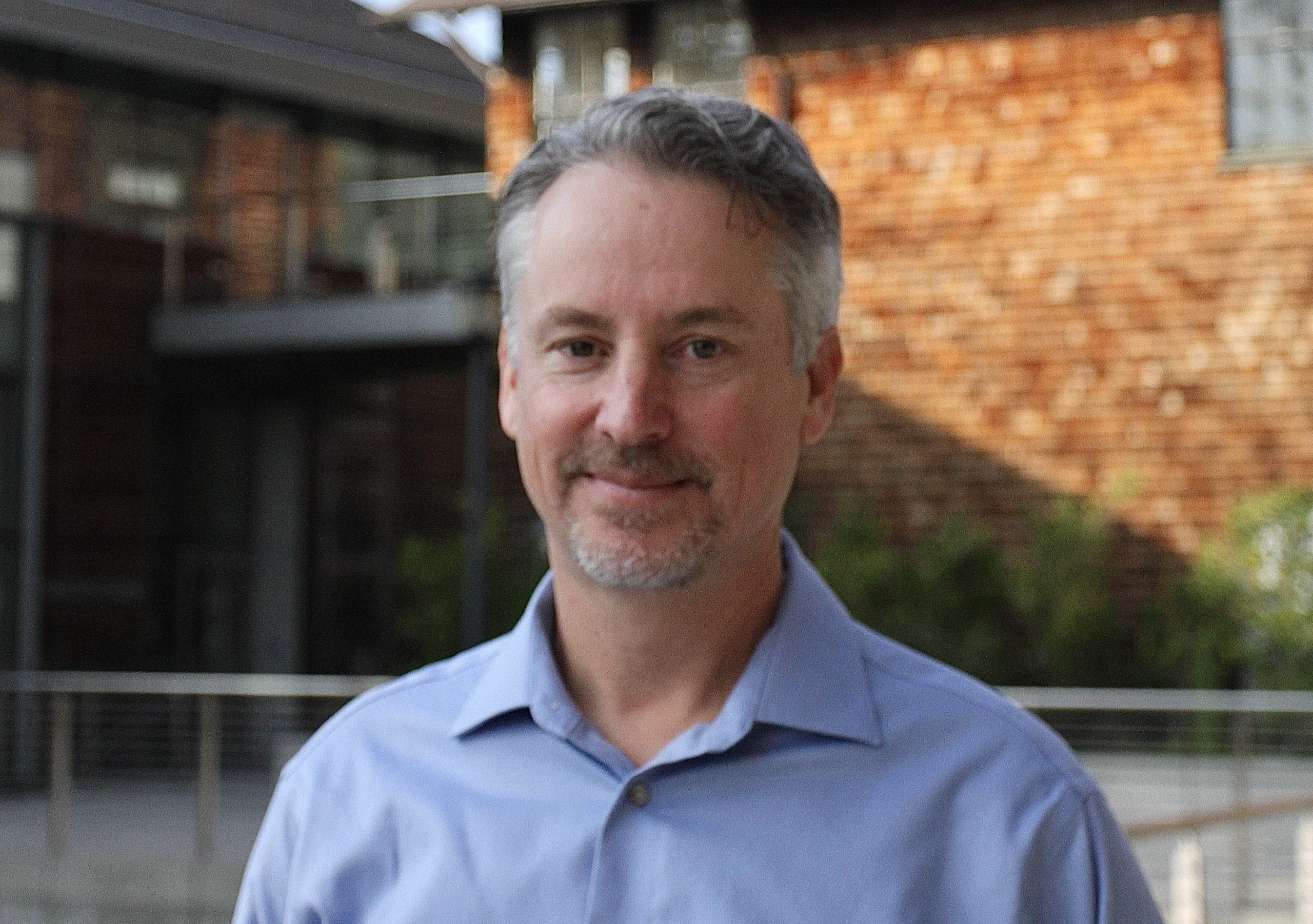
For nearly twenty years, Dr. Christopher Jones has been at the forefront of climate behavior research, most notably through his work with the CoolClimate Network and the Behavior, Energy and Climate Change (BECC) conference. A longtime collaborator, Dr. Jones is now bringing his expertise and innovative programs to the California Institute for Energy and Environment (CIEE). From developing the first-ever household carbon calculators to designing city-level engagement tools, his work has always been about more than just data; it’s about understanding what actually moves people to act. We sat down with him to talk about his move to CIEE, the surprising psychological drivers behind climate action, and his vision for the future of community-led change.
What brought you to CIEE?
I’ve been running the Cool Climate Network for about twenty years, primarily based in Berkeley’s Energy and Resources Group. My longtime colleague and supervisor retired, and I found myself needing a new institutional home.
Simultaneously, I’d already been working closely with CIEE for years— especially through my involvement with the Behavior, Energy and Climate Change Conference (BECC). I’ve been helping with BECC in some capacity for fifteen years now, so there’s a long-standing relationship. In many ways, it already felt like I was working with CIEE. Moving the program here just felt like a natural fit; it already felt like home.
How would you describe the Cool Climate Network’s mission and impact?
In many ways, BECC and the Cool Climate Network are deeply connected for me. I attended the very first BECC conference in 2007 as a poster presenter while finishing my master’s project at Berkeley. At the time, I was working on a carbon footprint calculator— something that, surprisingly, hadn’t really been done yet at a household scale.
One of the early ideas was allowing users to input their location and see how their carbon footprint compared to other cities. The goal wasn’t just information for its own sake, but behavior change. That calculator has been online since about 2005 now, and millions of people have used it through classes, cities, and organizations. But over time, it became clear that information alone doesn’t really change behavior. That realization pushed me to focus more on the human side—understanding what motivates people, what barriers they face, and how we can design systems that help people do things they already want to do, but struggle to act on.
That shift led to statewide behavior change programs across California. We ran competitions between cities and later across all ten UC campuses in 2015 and 2019. In total, about 20,000 people participated, taking over 200,000 documented climate actions. These weren’t just button clicks—participants had to describe what they actually did. Seeing that level of engagement was incredibly motivating and showed how data could be transformed into something far more powerful when paired with social design.
When working with such large populations, was there anything that surprised you about people’s behavior?
One of the most surprising findings came from our surveys, which tens of thousands of participants have taken: People across the political and ideological spectrum participated—and performed—similarly. Even participants who were skeptical of climate change often took just as many actions.
That’s because people engage for many reasons beyond climate belief: saving money, practicality, convenience, or community pride. Interestingly, people with stronger pro-climate beliefs didn’t always have better behaviors. More educated people often had higher carbon footprints, even at the same income level, because they traveled more and consumed more.
We also learned that extrinsic rewards—like gift cards—can actually backfire. People reacted negatively to the idea that their efforts were being reduced to a small prize. What truly motivated them was feeling proud, feeling connected, and seeing their actions matter within a community context.
You recently presented new work at BECC. How has your project evolved? What’s your current focus?
Our newer project focuses on city-level climate dashboards. Through climateplans.org, anyone can enter a California city and see not only its greenhouse gas inventory, but also detailed data on transportation, buildings, equity, income, education, and affordability.
The goal is to ensure that as we address climate change, we’re also paying attention to who benefits and who bears the costs. Climate action has real impacts on people’s lives, and those impacts aren’t distributed evenly.
What BECC helped me realize is that even rich datasets won’t drive change on their own. Communities need to own the data. That insight fundamentally transformed the project. Instead of building a static data portal, we’re now building what we call a community engagement portal—something interactive, locally customized, and driven by what communities actually care about, whether that’s climate, affordability, safety, or livability.
What does the community engagement portal look like in practice?
At its core, it combines several elements. Cities will still have access to robust data, but layered on top of that are tools like household and business carbon calculators, as well as our challenge software.
The challenge platform works a bit like a social feed— it shows actions people are taking in their community. Participants can earn points, join teams, and motivate one another. Many sustainability actions are invisible, so making them visible—and rewarding people with positive feedback—helps normalize them.
We use behavioral strategies like social norms, gamification, and tailored messaging, all informed by years of research. But the key is that it has to be local and community-driven. It’s not about imposing values, but creating a space where people can engage with issues they already care about and learn from one another.
What impact do you hope this work will have on the future?
Our greenhouse gas inventories and projections for California cities have revealed some important lessons for state and local climate policy. Before this work, I felt pessimistic about the probability of cities reaching ambitious climate targets, but now I’m seeing that many of those targets are within reach with some focused effort. The state is doing the vast majority of the regulatory work to meet state—and by translation, local—greenhouse gas reduction targets, but local governments are needed to help implement policies, track progress, and advocate for vulnerable communities. I’m hopeful that our dashboard tools can play an important role in this transition.
Are there any communities, sectors, or emerging technologies you’re especially interested in engaging with?
Electrification is the future of climate action in California. We need to electrify our motor vehicles, buildings, and much of our industrial production in the next two decades, but this will not be possible until the state does something to lower the cost of electricity. Although we’re not there just yet, I’m optimistic that with enough thoughtful planning and community advocacy, California will address this issue too.
Looking back on nearly twenty years with BECC and the Cool Climate Network, what are you most proud of?
If I had to name one thing, it would be innovation. Identifying important problems that surprisingly no one has tackled yet, and just doing them.
No one had calculated the average U.S. household carbon footprint, so I did. No one had created neighborhood-scale, consumption-based emissions inventories for cities, so we did. Many of these projects felt like obvious gaps—things that should exist—but didn’t.
I try to emphasize this to my Berkeley students as well: there are enormous, high-impact projects that aren’t necessarily difficult—they just require someone to take initiative. Too often, people assume something is outside their field or too complex, when, in reality, it just hasn’t been prioritized yet.