
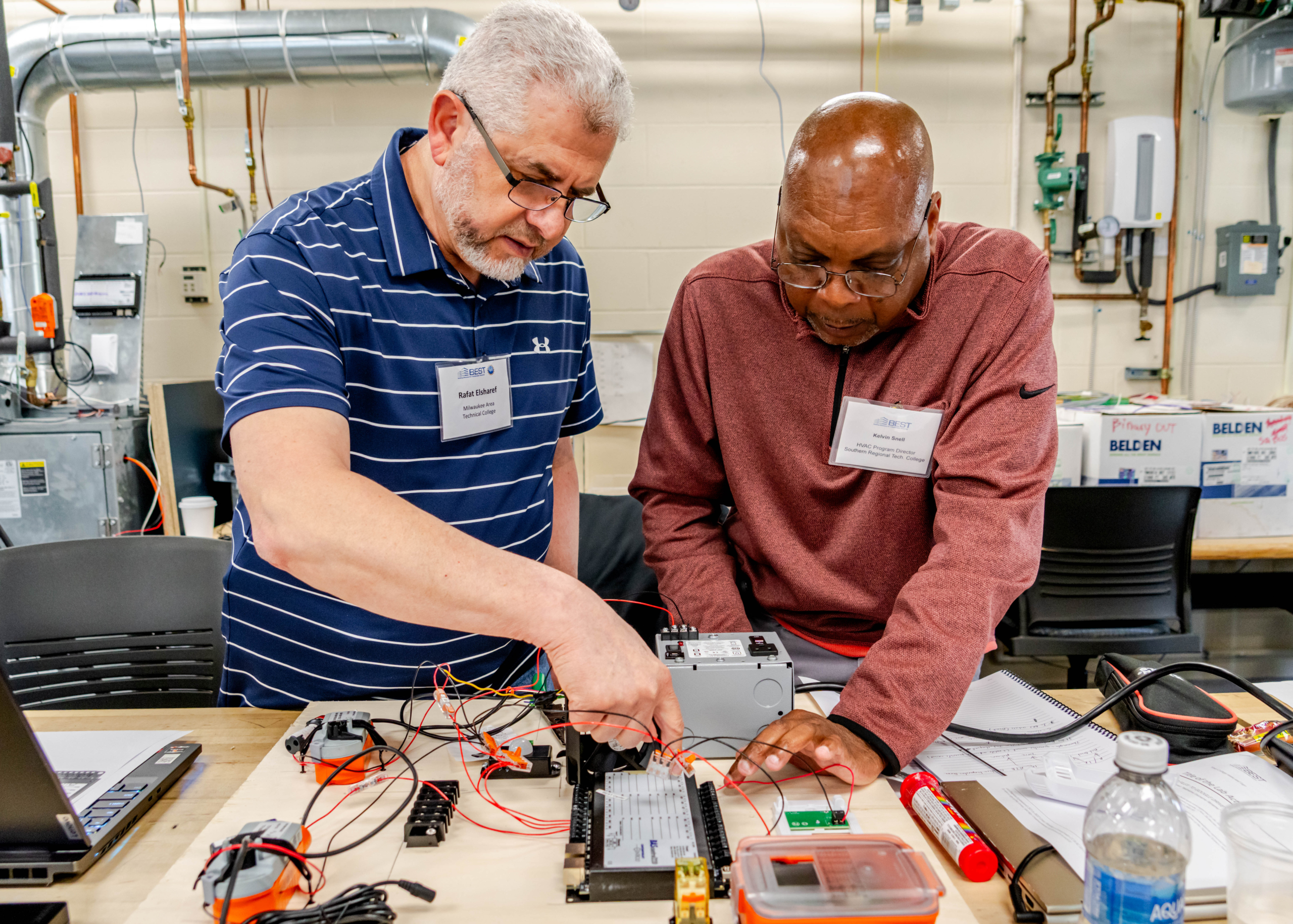
In June 2025, CIEE’s Building Efficiency for a Sustainable Tomorrow (BEST) Center hosted its fourteenth Building Automation Systems (BAS) workshop in Milwaukee, Wisconsin, bringing together instructors from across the country for five days of hands-on training, technical discussion, and curriculum development. Held at Milwaukee Area Technical College (MATC), the event marked a return to fully in-person programming. Participants worked on control wiring and logic programming, and toured energy systems that are usually hidden behind the scenes. The week emphasized one key message: The future of energy-efficient building design starts in the classroom.
Laying the Foundation: Wiring, Networking, and Control
The workshop began with core BAS concepts: wiring, sensor calibration, and controller setup. Attendees worked with BAS emulators, practiced device logic, and shared strategies for teaching introductory controls. These early labs helped establish a shared baseline among instructors with varying levels of experience. By day two, the focus shifted to digital networks. Using tools to assign IP addresses and establish device communication, participants practiced diagnosing common network issues, helping them develop the digital fluency that has become essential to mechanical skills.
Later, instructors built a two-fan relay system controlled by BAS logic. They worked in small groups to program control sequences that turned the fans on and off based on sensor readings and control signals. Along the way, participants had to troubleshoot wiring errors and adjust their logic until the system worked as intended. The variety of solutions showed how BAS instruction encourages flexibility and how troubleshooting can be one of the most valuable parts of the learning process.
Diagnostics and Systems Thinking
Day three emphasized the importance of problem-solving through technical lab work. In one workshop, participants examined and diagnosed an overcooling issue in a simulated office building. The system appeared to be running normally, but upon inspection, it revealed a failed damper actuator. The participants’ takeaway: real-world diagnostics require digital innovation and innovation, combined with hands-on physical assessments of situations.
Additional sessions used simulation platforms and physical models to test system efficiency, resilience, and responsiveness. Participants had the opportunity to experiment with machinery and control their settings, watching how small edits they made drastically affected the technology’s performance. The immersive labs helped students to imagine the pace and unpredictability of electrical work, programming, and system control.
Infrastructure and Peer Collaboration as Curriculum
As the week came to a close, participants toured MATC’s steam system and visited a nearby commercial building to explore their advanced array of controls. Seeing real equipment helped connect classroom instruction with real-world efficacy impact. These visits emphasized that buildings are not just topics of study; they are lived environments that can be understood and improved through direct experience.
The challenges the participants faced throughout the workshop—such as limited lab space and varied equipment familiarity—mirrored real classroom conditions, sparking vibrant conversations about adaptability and equitable access to education. Instructors discussed how to bring workshop content to their classrooms: by scaling down labs, sharing technological diagrams, and utilizing new learning software, or adjusting terminology to make concepts clearer. The week underscored that effective BAS instruction isn’t just about technical skill; it’s about building bridges between students and teachers, the classroom and workplace.
A workshop participant expressed his gratitude for the experience, noting, “This workshop will have a significant impact on our students’ education and the surrounding community, where it is greatly needed.”