
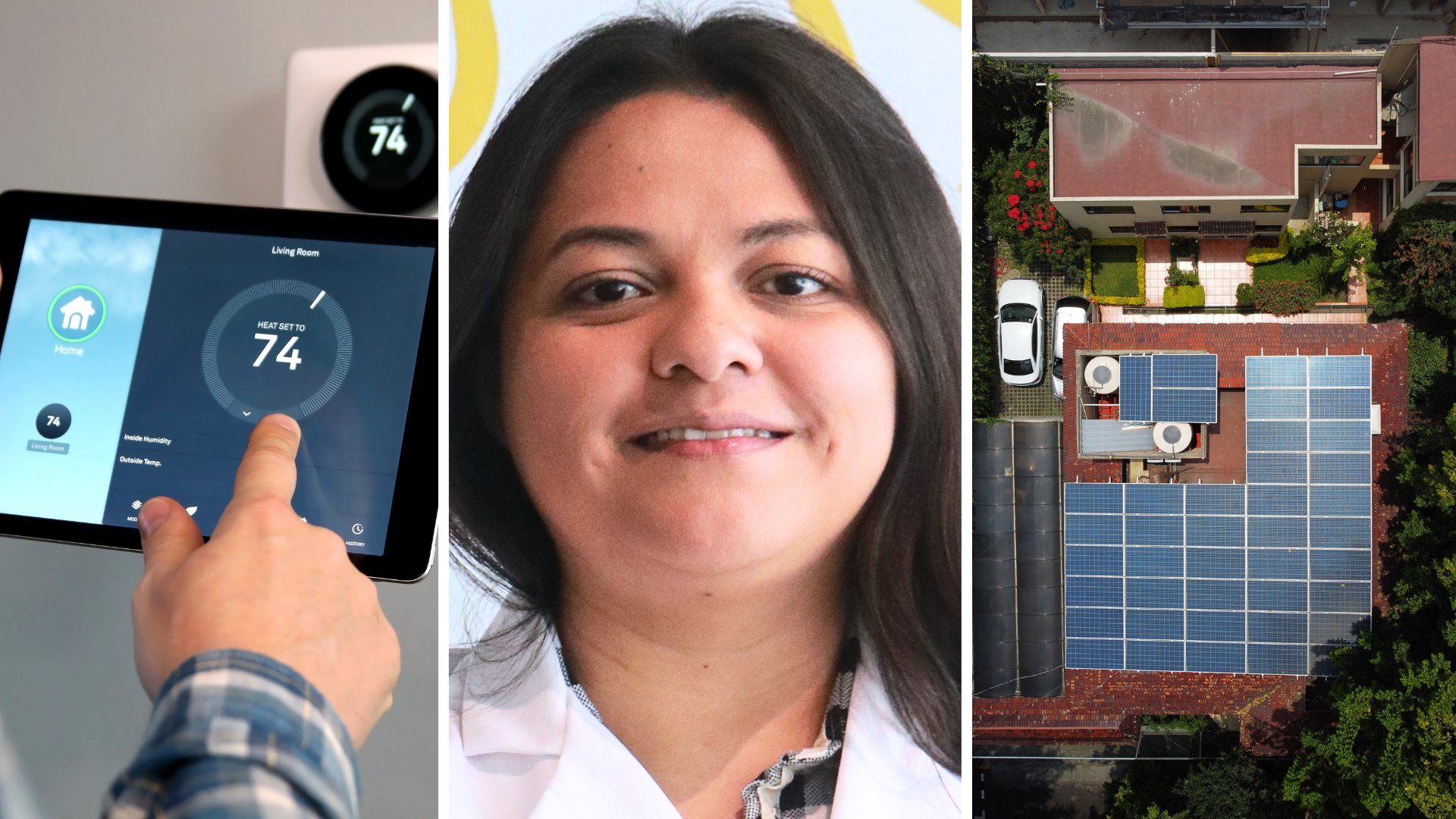
When Dr. Isabel Méndez first arrived at UC Berkeley in 2020, she wasn’t chasing a single technology—she was chasing a question: how do the daily choices of individuals shape the way entire communities consume energy? That question brought her from her Ph.D. program at the Monterrey Institute of Technology to a formative visit at UC Berkeley. During that visit, she met Dr. Therese Peffer, a pivotal connection who would become her Ph.D. advisor and long-term collaborator. After returning to Mexico to continue her doctoral research, Méndez earned a prestigious Fulbright fellowship in 2024 to come back to Berkeley and focus on a deceptively simple device: the thermostat.
Rethinking the Smart Thermostat
In Mexico City, where Méndez was born and began her academic journey, rising temperatures and limited access to air conditioning have made thermal comfort a daily challenge. While her early research explored physical solutions like retrofitted materials and shading devices, she soon realized that building infrastructure was only part of the problem. The other half was the people inside it. Their habits, preferences, and even moods determined how much energy buildings actually used.
At CIEE, Méndez began focusing on one of the most powerful objects in a home: the thermostat. She saw how even small changes—like raising the setpoint by just one degree Celsius—could reduce a household’s energy bill by six percent. But how do you encourage that behavior? Her solution was to design “serious games”—interactive tools that use game-like elements (such as progress tracking, visual feedback, and goal-setting) to teach energy-saving habits in a fun, intuitive way. These games don’t just simulate choices; they reveal the real-world consequences of each setting and encourage users to experiment with more sustainable behavior.
Alongside this, she implemented fuzzy logic, a mathematical modeling approach that mimics human reasoning by handling nuance and ambiguity, something traditional systems often lack. Rather than classifying temperatures as simply “hot” or “cold,” fuzzy logic allows thermostats to interpret comfort on a spectrum, like a person might. This means the system can adjust more sensitively to small preferences or changes, reflecting how people actually feel in their homes.
Making Conservation Conversational
Her Fulbright fellowship launched the most groundbreaking phase of this work yet: using artificial intelligence not just to process data, but to speak our language. Méndez is pioneering an interface that combines fuzzy logic and personality profiling with large language models (LLMs), creating smart thermostats that respond with everyday language instead of raw numbers. These AI-enhanced systems can explain energy savings, identify inefficiencies, and offer reminders in a tone that feels friendly and accessible.
This shift is a game-changer for communities traditionally left out of energy tech—seniors, rural households, and users unfamiliar with technical systems. By turning thermostats into conversational partners, Méndez hopes to close the gap between energy-efficient tech and the people it’s meant to serve. Instead of expecting people to adapt to tools, her vision reimagines the tools to adapt to people.
Looking Ahead
At CIEE, Méndez and Peffer are developing prototypes that embed LLMs directly into smart thermostats, making them adaptive, emotionally intuitive, and easier to use across cultures, ages, and literacy levels. These devices wouldn’t just adjust temperatures—they’d hold conversations about comfort, cost, and environmental impact. Through this work, Méndez is redefining what it means for a building to be “smart,” placing empathy, trust, and accessibility at the center of the energy transition.
Méndez also hopes to expand this work into underserved communities, where energy decisions are often shaped by necessity rather than preference. Her ultimate goal is to create systems that serve everyone, not just those who already know how to use them. By embedding natural language into climate tech, she’s designing tools that speak for, and with, the people who need them most.
“Energy is not just technical,” she reflects. “It’s social. It’s behavioral. And when we design with that in mind, the solutions can truly transform how we live.”