
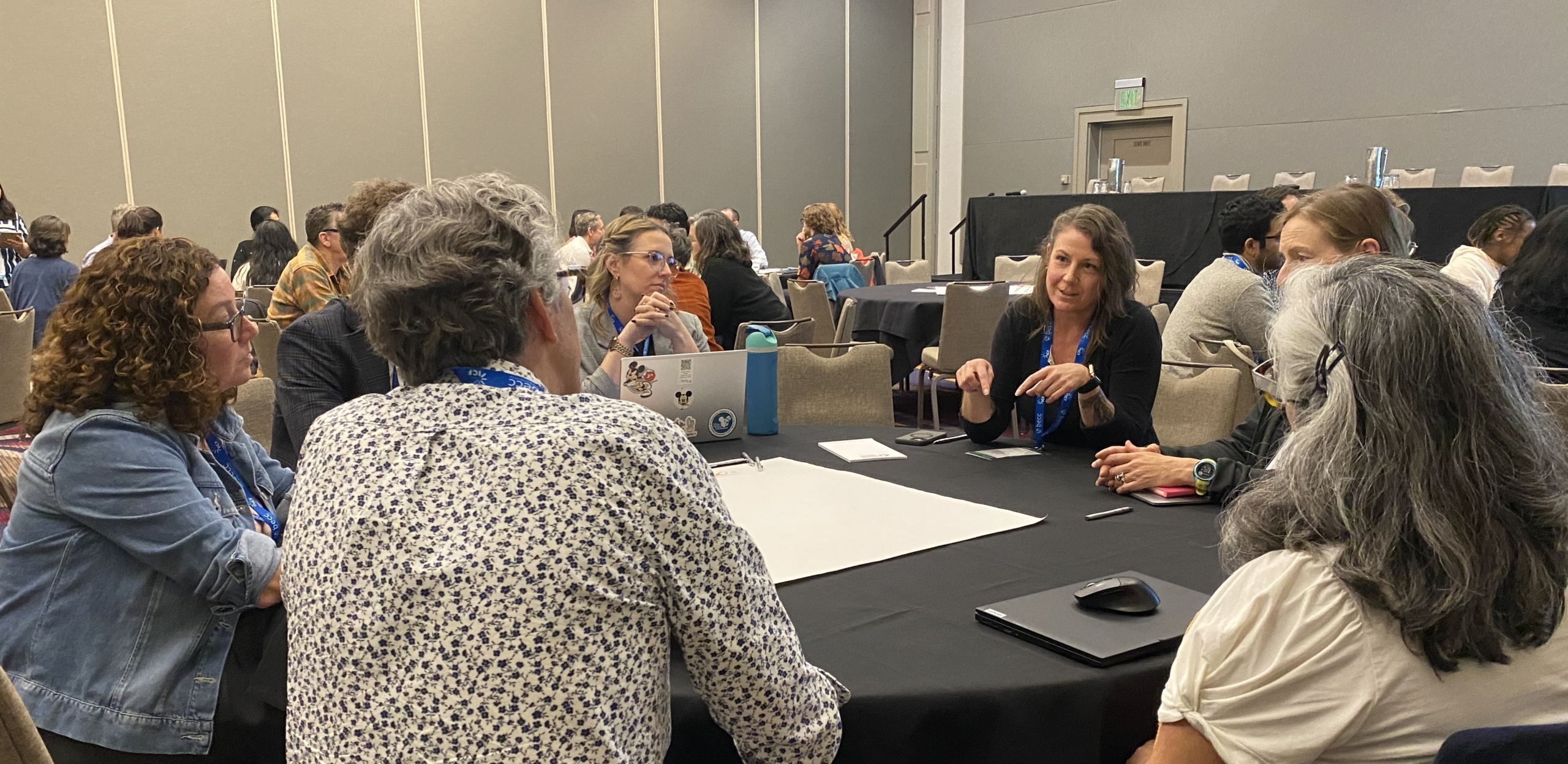
On November 5th, energy researchers and academics from around the world convened for the 2025 Behavior, Energy, and Climate Change (BECC) conference in Sacramento. The post-conference workshop “Community-Led Decarbonization: Behavioral Opportunities and Barriers” brought more than 40 participants from across the U.S. and abroad together to discuss how social patterns, equity goals, and public engagement can accelerate the clean-energy transition. The session was led by CIEE’s Dr. Therese Peffer and Dr. Chris Jones, with CIEE researchers Rich Brown, Dr. Isabel Méndez, and Emilio Camacho in attendance. With support from the France-Berkeley Fund, visiting colleagues Dr. Nathalie Ortar and Dr. Aurore Flipo were also able to join the conference and workshop. Attendees included PhD students, city officials, and community advocates from Oregon, Florida, California, Arizona, and England— all working toward a shared goal: to make energy efficiency and decarbonization accessible to everyone.
From Individual Action to Systemic Change
The workshop began with an acknowledgment of the scale of behavioral change required to meet decarbonization targets. Chris Jones opened with a presentation emphasizing that meaningful progress depends on understanding people’s motivations, values, and social norms, rather than simply their energy use. He urged participants to think beyond the individual and toward patterns of collective behavior: What motivates communities to act together, and how can engagement be designed to amplify that momentum?
Participants discussed proven strategies for encouraging environmental behavior, from tailored information and comparative feedback to public commitments and community-based rewards. As one attendee summarized, “accountability is contagious.” The conversation highlighted how community-driven messaging, public recognition, and shared success stories can shift norms and make climate action social, visible, and emotionally resonant.
Learning from Practice
A central case study came from the CoolCalifornia Challenge, a three-year UC-led initiative in which students and residents were rewarded for sustainable choices such as carpooling, layering clothing instead of using heating, and posting daily updates online. In 2015, over 22,000 students completed ten or more climate-friendly actions, demonstrating how gamified public engagement can translate awareness into measurable carbon reductions.
The group also heard from Marna Schwartz of the City of Berkeley, who described a pilot fund supporting local electrification and resilience projects. Berkeley distributed e-bikes to residents and tracked usage to assess the program’s impact on the community. The initiative revealed how civic partnerships can uncover residents’ true priorities: air purifiers, induction stoves, and bus passes ranked among the most requested resources. “People choose what they can use,” Shorts noted, underscoring that successful programs meet practical needs first and build climate engagement from there.
Christine Selig of ¡PODER! and Emerald Cities NorCal followed with insights from Whole Home Demonstration Projects, which retrofit older homes to improve comfort, safety, and resilience. Selig’s team worked closely with residents, showing how community trust and visible progress help turn policy goals into lived improvements.
Collaboration through Conversation
Later in the afternoon, participants joined a World Café discussion series— six rotating tables where hosts led dialogues on topics including rural energy access, financing and equity, NGO collaboration, and integrating non-governmental efforts into local planning. Each round built on the previous one as participants responded to written prompts and layered ideas together.
Key takeaways emerged: the importance of meeting people where they are, partnering with trusted messengers from within each community, and maintaining transparency in how resources and funding are distributed. Many stressed that building a clean-energy future depends on sustained local investment: hiring locally owned contractors, keeping funding within the community, and supporting micro-enterprises that grow from the ground up.
Equity at the Center
Throughout the day, discussions returned to one unifying idea: decarbonization must be equitable to be effective. Participants considered how unpermitted housing, limited access to efficiency tools, or a lack of financial literacy can exclude vulnerable residents from clean-energy programs. To counter this, they proposed expanding local knowledge of tools and incentives, integrating workforce training, and developing champions who can represent underserved groups.
By the end, the workshop had transformed into a collective brainstorm of what community-led decarbonization could look like across diverse contexts, from rural towns to dense urban neighborhoods. As one participant put it, “People want to invest in their futures; our job is to help them see why energy efficiency is part of that future.”