
Researchers at UC Berkeley’s Center for the Built Environment (CBE) and the California Institute for Energy and Environment (CIEE) are developing low-power personal comfort devices (PCDs) to give office workers individualized thermal control while significantly reducing building energy consumption. Launched in 2024 with funding from the California Energy Commission, this two-year project integrates localized heating and cooling into existing building management systems.
The project brings together collaborators across academia, national laboratories, and industry. Key partners include UC Berkeley’s EECS’s Lab11, Lawrence Berkeley National Laboratory, engineering firm Arup, TRC, and Normal Software. Together, the team is exploring how localized comfort technologies can improve workplace comfort while enabling more energy-efficient building operations.
Localized Comfort, Lower Energy Use
Rather than attempting to heat or cool an entire floor to satisfy every occupant, PCDs provide targeted thermal relief to specific parts of the body. This approach builds on decades of thermal comfort research at CBE, showing that specific body regions strongly influence overall comfort perception. For example, cold hands or feet lead to a perception of whole-body discomfort in cool environments, while a warm face or head dictates overall discomfort in warmer conditions. By addressing these localized discomfort points, buildings can shift their thermostat setpoints by a few degrees without sacrificing occupant happiness, leading to substantial energy savings.
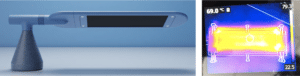
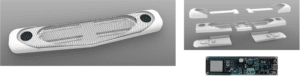
As part of the project, the team developed two new PCD prototypes designed for office environments. One is a desktop hand warmer built with a nano-fabric heating material made from carbon nanotube sheets. The material radiates heat efficiently while remaining safe to touch. The second prototype is a heated and cooled desktop wrist pad, which regulates temperature at the wrist—one of the body’s fastest thermal response points—using integrated heating elements and small fans. Both devices operate at extremely low power levels, around 20 watts, compared to typical office space heaters, which can consume 1,000 to 1,500 watts and often create challenges for building managers.
Next Steps: Smart Integration and Bench-Testing
A key component of the project is the development of an open-source desktop hub, equipped with sensors for air temperature, humidity, carbon dioxide, occupancy, and power consumption. The team is currently building software and a dedicated dashboard that will allow users to control their local devices, such as existing heating devices, chairs, and/or portable air cleaners, which will receive data gathered from the hub sensors and allow users to control individual devices locally, while connecting and sharing data with the central building management system. Researchers are also considering the best ways to quickly and easily integrate PCDs into the building management system, defining an integration strategy and developing semantic models to represent PCDs so that the software will work with any building automation system, regardless of the manufacturer. “Being able to connect the PCDs to the automation systems is where you’re really going to save energy, [by] making that connection,” explains Dr. Therese Peffer, a co-PI and the PCD project manager.
The team has also examined potential real-world applications for these devices. Personal comfort technologies could help address common challenges in open offices where occupants have conflicting thermal preferences, reception desks near frequently opened doors, and “rogue zones” in buildings where uneven heating or cooling drives unnecessary HVAC demand.
In the coming months, researchers will test the devices in controlled laboratory environments at CBE’s climate chamber before field testing the systems in real buildings, including spaces at UC Berkeley. To support broader adoption, the project will also produce a web-based design guidebook developed with Arup, helping architects, engineers, and facility managers identify effective ways to incorporate PCDs into building design and operations.
By combining localized comfort technologies with smarter building controls, the project is demonstrating how small-scale solutions can contribute to more flexible, energy-efficient buildings.