
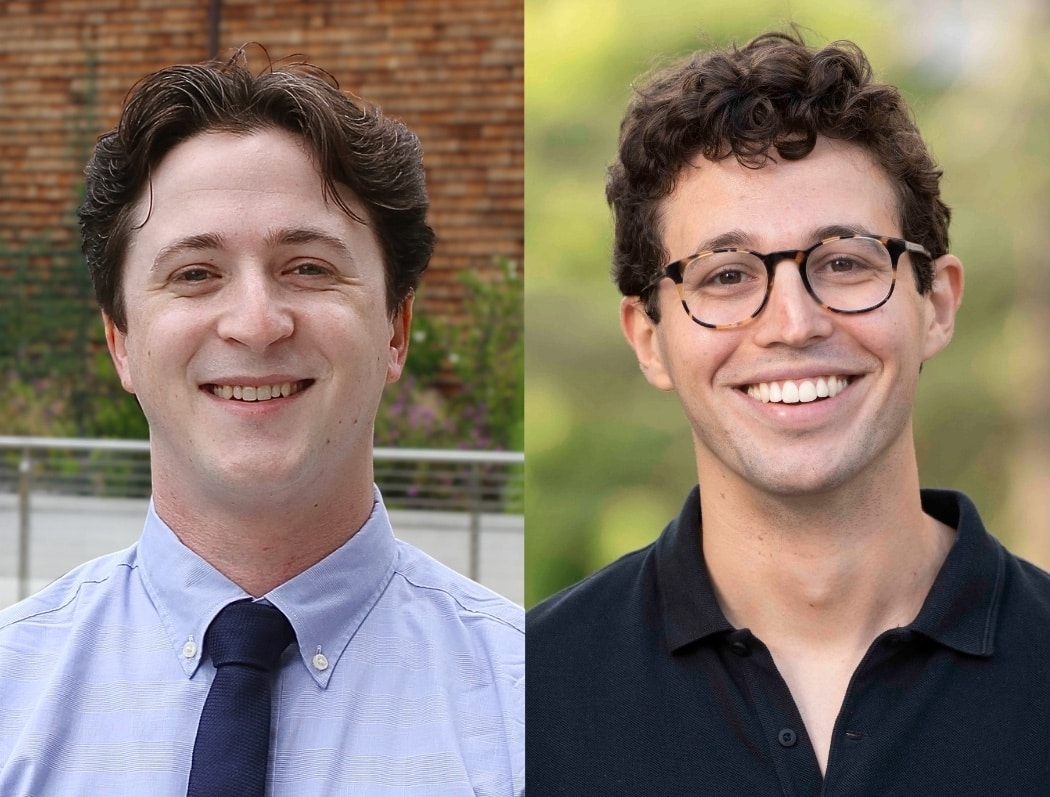
Neither Chris Hunter nor Bora Ozaltun set out to study energy efficiency— and yet both arrived at it through a version of the same realization: that some of the hardest problems in the energy transition aren’t technical ones. Hunter is a master’s student jointly enrolled in UC Berkeley’s Energy and Resources Group and Goldman School of Public Policy (GSPP); Ozaltun is a PhD candidate in the Department of Agricultural and Resource Economics. This year, their work is recognized jointly by the Art Rosenfeld Award, with the fellowship’s inaugural second $10,000 award made possible through the generous support of donor Randy Wu.
Hunter came to the field through local government, spending five years at StopWaste in Alameda County doing outreach for regional retrofit incentive programs, where his days were spent talking to homeowners, landlords, contractors, and tenants about why energy upgrades were worth their time and trouble. It was, as he describes it, a deeply human education in a field that often forgets its human dimension. “I really got to understand energy efficiency from the perspective of the actual residents and people installing it,” he says, “rather than from a technical engineering standpoint.” The more he saw of these programs from the inside, the more he noticed how they were falling short, and the more he felt the pull toward graduate school, where he could gain the tools to fix them, rather than promote them as they were.
Ozaltun’s path was longer and more circuitous, moving from civil engineering to computer science before landing at MIT’s Technology and Policy Program, which offered the combination of engineering rigor and social science depth he’d been searching for without quite knowing it. A tip from a postdoc nudged him toward economics; a publicly available data set at Berkeley’s Energy Institute nudged him toward contractors. By the time he arrived at his research question, it had found him as much as he had found it.
The Overlooked Side of the Equation
What makes both fellows’ work distinctive is that they’ve each trained their attention on the people and institutions that energy efficiency policy tends to pass over.
For Hunter, that means tenants: the residents of multifamily buildings who have no say over whether their landlord applies for a retrofit program, no control over what gets installed, and no guarantee that the improvements will benefit them. The concern is one he heard directly, again and again, while leading listening sessions to redesign a multifamily retrofit program at StopWaste: renters wanted to know how they could trust that a landlord wouldn’t pocket the subsidy, upgrade the unit, and use the renovation as justification to increase rent. “We really didn’t have an answer to that,” Hunter says, “because we didn’t track long-term outcomes. Our involvement stopped as soon as the project was finished.” That absence of follow-through, a structural gap between the moment a program declares success and the lives it was meant to improve, became the animating question of his research.
For Ozaltun, the overlooked party is the contractor: the licensed HVAC installer who has to make a costly, uncertain bet on a new technology while still running a business built around the old one. Becoming a licensed contractor in California requires six to seven years of training and apprenticeship, substantial upfront costs, and the supplier relationships that take years to build, and even then, adopting heat pump technology means investing in something that competes directly with the fossil-fuel-based systems that currently pay the bills. “It’s not just households that we want to adopt this technology,” Ozaltun says. “Contractors have to make a costly decision too, and almost no one in economics has looked seriously at how they make it.”
The Data Behind the Research
When Hunter dug into how the programs he’d worked on actually measured their impact, he found a metric calibrated to reporting requirements rather than the needs of residents. The public purpose program surcharge that underwrites these programs requires recipients to demonstrate energy savings in order to access funds, which means that questions about tenant wellbeing, rent increases, or displacement risk exist entirely outside the official accounting of whether a program worked. Equity goals were eventually layered on top, but remained loosely defined and harder to measure. His research aims to fill that gap by quantifying the degree to which retrofit subsidies may be flowing through to higher rents— and identifying which communities and property types are most exposed to that risk.
Ozaltun’s data told a similarly complicated story. Looking at California’s rebate programs, he found that between 40 and 60 cents of every subsidy dollar went to contractors, who adjusted prices based on incentives available. The intuitive reaction is to flag this as waste or capture, but Ozaltun is careful not to jump there. “It’s not necessarily bad,” he says, “because if we have learning costs on the contractor side and we want them to adopt, then maybe these pass-through estimates are actually what the policy needs.” The question his research is working toward isn’t whether contractors are capturing too much, but what the optimal balance looks like, and how program design might be adjusted, location by location, to get there.
What the Rosenfeld Award Makes Possible
For both fellows, the $10,000 Rosenfeld Award translates into something straightforward and essential: the protected time to spend the summer fully immersed in their research, rather than splitting their attention across teaching and other graduate responsibilities. Hunter had anticipated working close to full-time to cover his costs; the grant clears enough space for him to focus on building the data infrastructure his thesis depends on. Ozaltun needs to design and run two surveys—one aimed at households, one at contractors—that are central to his empirical work and expensive to execute well. “Without these funding sources,” he says, “I was going to have to work on other projects, and not be able to spend as much time on this research as I’d like.”
Both see the recognition itself as meaningful in a field that doesn’t always feel like a priority. Hunter notes that energy efficiency tends to get treated as a solved problem, even though the work of retrofitting and rehabilitating existing buildings, and ensuring that work reaches the people who need it most, is far from finished. “There’s so much more to be done,” he says, “and if we get efficiency right, it makes every other part of the energy transition easier.”
Looking Forward
Hunter’s near-term goal is to produce research that gives program administrators something they can actually use: not just findings about California at large, but a methodological framework that local governments and state agencies can apply to understand displacement risk within their own communities and program portfolios. His GSPP capstone will take preliminary results to a client, such as a program administrator or state agency running a multifamily retrofit incentive program, and work with them to translate findings into policy recommendations. “In California,” he notes, “housing affordability and energy affordability are, in a lot of ways, the same problem.”
Ozaltun is oriented toward a broader theoretical horizon that extends well beyond heat pumps. The question of how incumbent firms decide to adopt technologies that compete with their existing business—the same dynamic playing out in electric vehicles, in manufacturing, across the industrial economy—is one that empirical economic research hasn’t fully grappled with in the context of the clean energy transition, and his work on contractors is one window into it. Quantifying how existing firms behave differently from new entrants, and what that means for policies trying to accelerate the green transition, is the larger contribution he hopes his dissertation can make.
The Art Rosenfeld Award for Energy Efficiency honors the legacy of Arthur Rosenfeld, the Berkeley physicist whose advocacy gave California’s energy regulators the data they needed to enact some of the toughest efficiency standards in the world, a model that has since been replicated globally. Established by the California Institute for Energy and Environment and the Graduate Division, the award supports UC Berkeley graduate students whose research carries Art’s work forward.