
California’s more than 100 community colleges are vital to meeting the state’s climate goals, serving as the primary training ground for the workforce that will build, operate, and maintain clean energy systems. However, sustainability education at this level has historically been uneven, underfunded, and largely disconnected from the cutting-edge research shaping the field. In addition, because of their deep connections to local communities, California community colleges can serve as demonstration sites for technological innovations in facilities design, construction, and operations and for sustainable practices. To address these issues and opportunities, a new collaboration between the California Institute of Energy and Environment (CIEE), the Building Efficiency for a Sustainable Tomorrow (BEST) Center, and Lawrence Berkeley National Laboratory (LBNL), operating through the California Renewable Energy Laboratory (CREL), is working to transform the state’s clean energy educational landscape.
Bridging the Gap
The collaboration is led by Peter Crabtree, a visiting project scientist at CIEE and the principal investigator of the BEST Center, alongside Larry Chang, director of the BEST Center. Together, they’re leveraging CIEE’s research partnerships and the BEST Center’s national network of community college faculty to build a “community of practice” for high-performance building operations and education that reaches institutions across the state.
CIEE and the BEST Center are building a statewide network connecting community college facilities and sustainability directors, giving institutions that are often under-resourced and operating in isolation access to peer expertise, shared best practices, and input on new construction and retrofit projects. Alongside that effort, the initiative is working to integrate high-performance building concepts into academic and career technical programs in a way that sticks: not as an elective add-on, but as a core part of how future architects, engineers, and building technicians are educated.
The Campus as Living Lab
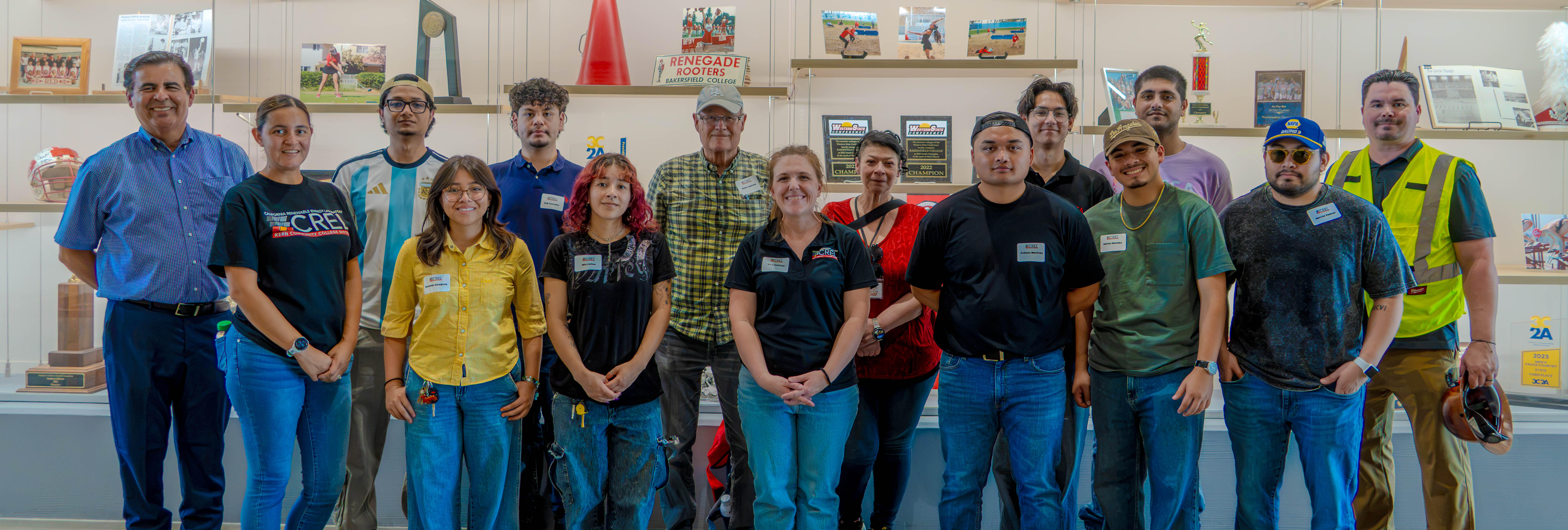
A pilot student research project currently underway at Bakersfield College offers an early window into how the project will unfold. 12 lower-division undergraduates from architecture, engineering, and computer science programs were organized into interdisciplinary teams to conduct detailed assessments of four campus buildings. Working alongside architects, LBNL researchers, and a building automation specialist, and supported by college facilities staff, they used blueprints and specs to determine insulation, lighting, window treatments, HVAC systems, and building automation infrastructure. Using utility bills, square footage estimates, and other analytical tools, the students calculated Energy Star Portfolio Manager ratings for the buildings. The students presented their findings along with campus energy improvement recommendations to a Kern Community College District audience that included the Chancellor, senior staff, and community members.
The project gives students an end-to-end view of how buildings are designed, built, and operated over their lifetimes, while exposing them to the messy realities of existing infrastructure: aging systems, incomplete records, and decades of piecemeal upgrades.
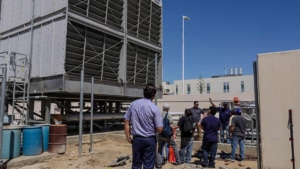
Crabtree describes it as a “campus as living lab” model, noting that the inherent unpredictability is a vital teaching tool. “It’s as if you were going to remodel your house,” he says. “Once you start opening walls up, you really don’t know what you’re going to find.” That unpredictability, rather than being an obstacle, is part of the point: students are learning how to ask good questions about buildings and systems they didn’t design, in conditions that closely mirror the work they’ll actually do.
A Blueprint for Scaling Impact
The 10-week project culminates in a final presentation, but the ambition reaches further, toward a replicable model that other California community colleges can adopt, using their own campuses as sites of applied research and hands-on learning.
For Crabtree, the most meaningful outcomes may be the ones hardest to predict. “With younger students like that,” he reflects, “you really don’t know where they’re going to go with all of this information.” That openness, the possibility that a first-year architecture student or a computer science major might end a 10-week project with a completely different sense of what their career could look like, is, in many ways, what the whole endeavor is looking to inspire.
Read more about the Kern Community College District’s CREL
Read more about the High Performance Buildings Center of Excellence project