
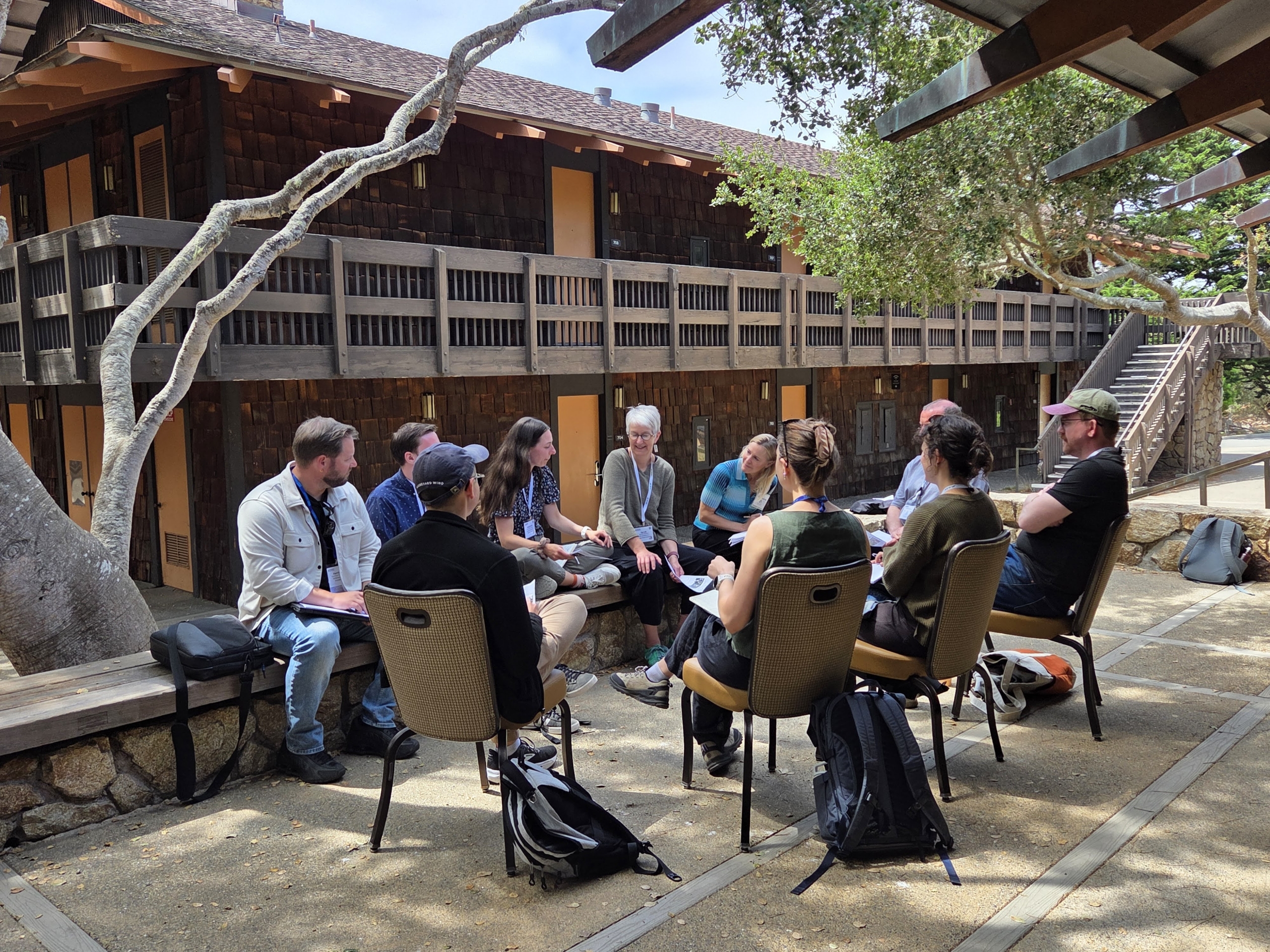
What does it take to decarbonize not just a building, but an entire neighborhood? That was the question at the center of “Block by Block: Scaling Community-Centered Neighborhood Decarbonization,” an informal session organized by CIEE, ACEEE, the City of Oakland, and Delta Arc Strategies at the 2026 ACEEE Summer Study conference in Pacific Grove, California. Roughly 45 researchers, policymakers, and industry professionals gathered for an hour of presentations, small-group discussion, and shared problem-solving, with the goal of not just exchanging ideas, but building an ongoing practitioner network committed to neighborhood-scale decarbonization.
The session opened with a lightning round of presentations grounding the conversation in real-world examples. CIEE Associate Director Dr. Therese Peffer introduced the Oakland EcoBlock, a neighborhood-scale decarbonization and resilience pilot that has informed California’s SB 1221 and been presented to the CPUC as a key case study. Emily Sims of ACEEE broadened the view with thermal energy network case studies from Ann Arbor, Framingham, and Ithaca. Melanie Colburn of the City of Oakland detailed how Oakland is translating EcoBlock’s lessons into policy, including a demonstration ordinance and amnesty resolution, and Kate Ringness of Delta Arc Strategies addressed the financing instruments, from CDFIs to third-party ownership models, that could make future EcoBlocks more affordable and replicable.
What the Field Is Learning
In the breakout discussions that followed, five themes emerged. First and most consistently, the biggest barrier to neighborhood decarbonization isn’t a technical matter, but one of trust. Residents need to feel the process is safe and accessible before adoption can scale, and the most effective entry points tend to be hyperlocal, peer-to-peer, and already trusted, from community health workers to neighborhood contractors to events like Bellevue, Washington’s “Heat Pump Parties.”
Second, municipalities are struggling to identify which homes are actually ready for electrification, pointing to a need for better building data and tracking systems. Third, installer capacity remains a critical bottleneck, particularly in rural areas where technicians face real costs—in lost business revenue, not just travel time—when training on new technologies.
Fourth, multi-stakeholder partnerships, including utilities, community organizations, and even homeowners associations, were seen as essential to driving participation at scale. Finally, the participants concluded that sustaining momentum requires long-term engagement: retrofits happen in stages, and the community of practice infrastructure needs to match that timeline.
What Comes Next?
The session closed with a discussion on how to turn the energy in the room into an ongoing conversation. Attendees pointed to concrete policy momentum, including Washington, D.C.’s new RFP for a scaled electrification program and California’s SB 1221, as tailwinds. As next steps, the organizing team plans to launch an email listserv and a decarbonization-themed webinar series, with the first installment planned for December 2026. One attendee, reflecting on the plans for a collaborative community that will continue the conversation put it simply: “I could just squirm with happiness.”