
Workforce Development, Energy Use in Buildings
CREL/CIEE Bakersfield College High-Performance Building Assessment Project Page
CREL, CIEE, the BEST Center, and Lawrence Berkeley National Laboratory are building a statewide community of practice for high-performance buildings and education, using California community college campuses as labs for applied research and workforce training.
California’s more than 100 community colleges are the primary training ground for the workforce that will build, operate, and maintain the state’s clean energy systems, yet sustainability education at this level remains uneven, underfunded, and disconnected from the research shaping the field. Led by Peter Crabtree and Larry Chang, this collaboration leverages CIEE’s research partnerships and the BEST Center’s national network of community college faculty to change that on two fronts.
The project connects community college facilities and sustainability directors, which are often under-resourced, into a statewide network with access to peer expertise, shared best practices, and input on one another’s new construction and retrofit projects. It works to embed high-performance building concepts into academic and career technical programs as a core part of how future architects, engineers, and technicians are trained, rather than an elective add-on.
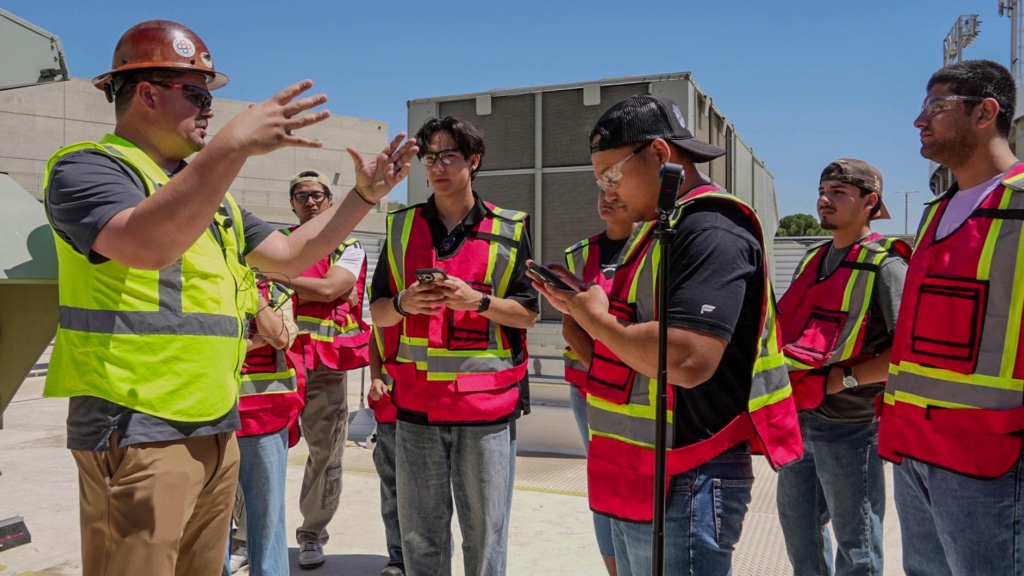
A pilot project at Bakersfield College demonstrated the “campus as living lab” model that ties these efforts together. Twelve architecture, engineering, and computer science undergraduates, organized into interdisciplinary teams and working alongside architects, LBNL researchers, and a building automation specialist, conducted detailed assessments of four campus buildings, examining insulation, lighting, window treatments, HVAC, and building automation systems. The work gave students an end-to-end view of how buildings operate over their lifetimes while confronting the realities of aging systems, incomplete records, and decades of piecemeal upgrades.
The 10-week project culminated in a final presentation, with the broader aim of producing a replicable model that community colleges across California can adopt, using their own campuses as sites of hands-on learning and applied research.